Hey Longhorns!
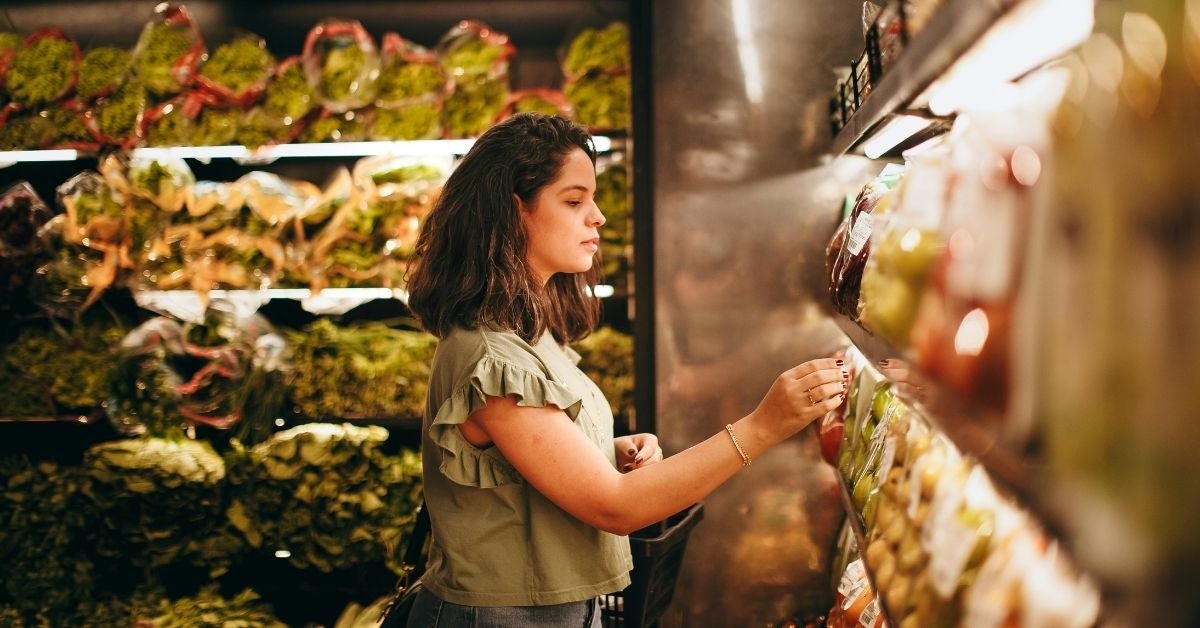
One of my favorite things about going abroad is exploring local grocery stores and comparing them to ones back home. Grocery shopping is like a window into culture, showing how a society lives and eats.
Texans are familiar with our beloved H-E-B, which carries a wide variety of goods and products and reflects our Texas pride. When we walk down Aisle 4 or 9, the shelves are stocked with many versions of a product, whether cereal, bread, or candy. We could spend a whole day in the grocery store, looking at the range of products. However, that experience will likely be different when you travel abroad.
During my experiences abroad in several countries, I have seen firsthand how vastly different American grocery stores are from shops abroad. During my times abroad, every accommodation had a kitchen with a refrigerator, stove, sink, microwave, and the basic necessities for students to cook.
Eating out every day can be costly, which is why grocery shopping might be an important endeavor while you’re abroad. To help you prepare for an international shopping experience, here are some noticeable contrasts I found at the world’s food markets.
London

I participated in a London May Term sponsored by the Clements Center for National Security in 2025. I was in London for about four weeks, with a few convenience stores within walking distance, including Tesco, Waitrose, and Sainsbury’s (my favorite). These corner stores can be found in small neighborhoods, making it easy to grab essentials within walking distance.
There are smaller-format stores such as Tesco Express, which make it easier for a quick trip rather than bulk shopping. Many locals tend to shop multiple times a week rather than make a single large trip. Markets in London are easily accessible through the city’s public transportation system.
A key feature of grocery shopping in London is variety. London has an extremely diverse population, allowing supermarkets to carry food from around the world. From South Asian spices to Eastern European staples, you can find international ingredients at a local corner store. While there, I stumbled across an Amazon Market with all the basic necessities one might need.
Every corner store I shopped at offered self-checkout, which increased efficiency and reflected the city’s fast-paced nature. Many stores did not offer free grocery bags, so keep that in mind for your next visit.
Budapest

In the summer of 2025, I went on a six-week faculty-led program to Budapest, Hungary. Our accommodation was in a very convenient spot, with an Aldi just around the corner. Alongside Aldi, Hungary had Lidl and corner stores very similar to CVS and Walgreens.
The Aldi was smaller than an H-E-B and offered fewer product varieties. For example, instead of having an aisle dedicated to cereal, Aldi offered a limited selection. In the dairy area, I noticed that the milk came in smaller cartons instead of plastic gallons, and some were not refrigerated. I would buy the unrefrigerated milk, put it in the fridge — and it didn’t go bad, to my surprise!
Additionally, I felt the shopping experience was slower-paced among locals. In Budapest, there is a historic market called the Central Market Hall where locals can buy fresh meat and spices. It reminded me of a farmers’ market, with open-air stands, seasonal produce, and personal interaction with vendors. The market also had vendors selling Hungarian souvenirs.
Next to our accommodation was another market hall, next to Westend Mall. It is a good place to check for fresh produce and fruit. Additionally, inside the Westend Mall were a few more grocery stores! This was new to me, as I have never seen grocery stores inside shopping malls. It was pretty convenient to find all forms of goods in one spot!
Seoul
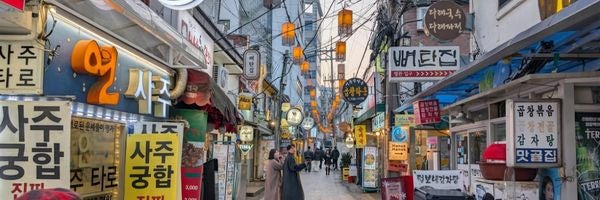
In July 2024, I interned in Seoul, South Korea, with a Korean company called Fobworld. Our accommodation wasn’t near a grocery store, but we were across the street from a 7-Eleven, which had what I needed for breakfast.
Convenience stores in Korea are defined by constant accessibility and a deep connection to food traditions. One can buy ready-to-eat items like kimbap, instant ramen, and lunch boxes; they are a quick and easy everyday solution for busy students and workers.
In South Korea, I saw more traditional markets than large supermarkets. These markets are social spaces where vendors interact with customers, offer samples, and maintain long-term relationships. More than a place to shop, a Korean market feels more personal than the impersonal feel of large supermarkets.
South Korea emphasizes freshness, as its cuisine often includes vegetables and side dishes. You will see that refrigerators tend to be smaller, which requires more frequent trips to the market. The 7-Eleven near my accommodation had milk, cereal, instant ramen, drinks, and ready-to-eat items, making it very easy to quickly grab what I needed.
Singapore
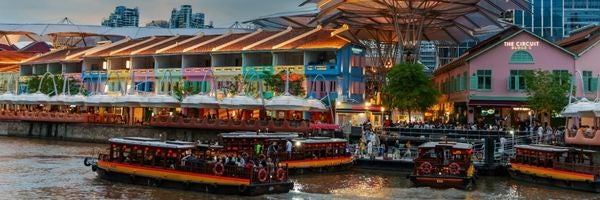
The International Relations & Global Studies 2024 May Term program in Singapore was my first study abroad program at UT. Our accommodation was conveniently located near shopping centers, a subway station, bus stops, and corner stores.
Food is considered a core part of national identity, with diverse influences shaping what people eat daily. Chinese, Malay, and Indian food are a big part of the national cuisine, but one can easily find food from all over the world. Hawker centers are popular in Singapore. They are open-air complexes with dozens of food stalls offering affordable meals.
In Singapore, because of the dense urban layout, you will likely find markets located within or directly below residential buildings, making them easily accessible. The supermarkets offer both local and imported goods. I checked out a store that imported many Japanese goods, and I still eat the same kind of cereal to this day! It was so cool to try out new kinds of international food items not found back home.
One can also find traditional markets that offer fresh meat, seafood, and produce, ready to be cooked. This can be helpful for anyone abroad looking to cook their own meals. Similar to Seoul, 7-Eleven stores are also widely accessible in Singapore. One thing to note is that because the country relies on imports, grocery shopping is tied to global supply chains, which can influence prices and availability.
Because public transportation is the most used form to get around the city, keep in mind that it can be hard to carry around groceries as you go home. It might be a good idea to bring backpack or cart to haul around your groceries.
Grocery stores are not just places to buy food. They are everyday spaces where one can glance inside history, culture, and economics. Each city has its unique features that distinguish it from another but also shares many similarities.
This blog was contributed by Alondra, a senior double majoring in International Relations & Global Studies and government, with a minor in Korean. Alondra has participated in multiple education abroad programs, including the 2024 IRG May Term in Singapore and Ho Chi Minh City; Absolute Internship in Seoul, South Korea; the 2025 Clements Center May Term in London, England; and the 2025 Politics, Society, and Security Summer program in Budapest, Hungary.