Before coming to Morocco, I thought I had a head start since I’m Egyptian. I grew up with Arabic as my first language, Islam shaping the rhythm of daily life, with the particular warmth of a culture that feeds you before it asks your name.
I figured Morocco would feel like a variation of something I already knew. Familiar enough to be comfortable, different enough to be interesting; but I was so far from right, and I’m so glad I was.
Now 10 days into a month in Rabat, I’ve found myself rethinking almost everything I assumed about this part of the world and about what it means to belong somewhere new.
The Moment I Come Back To
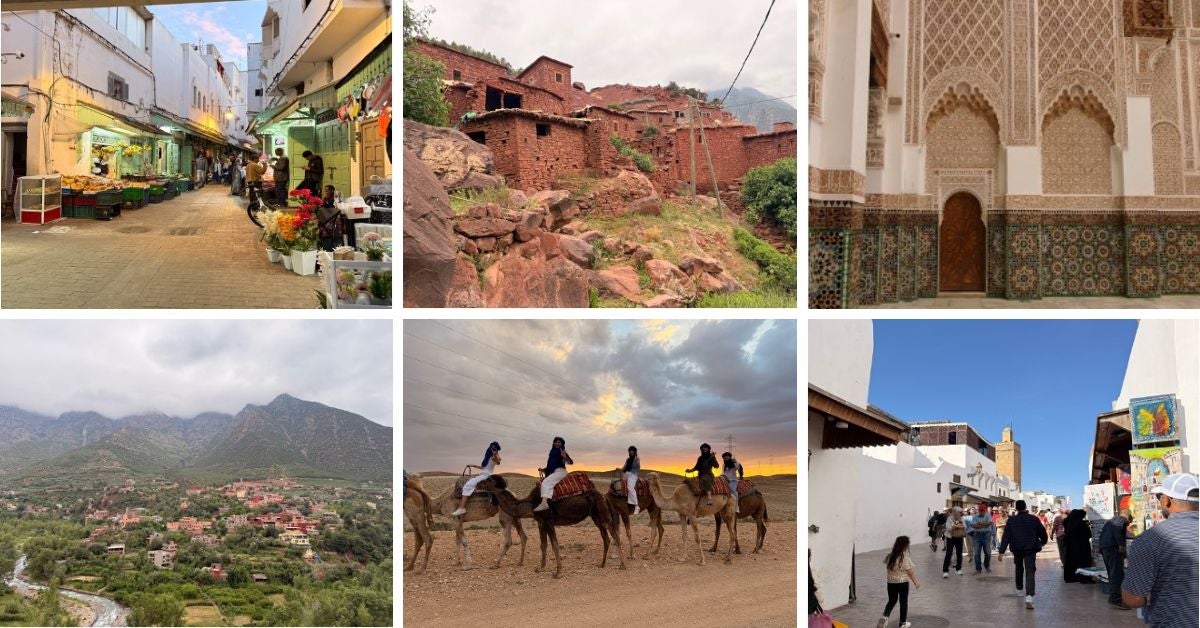
A specific moment I keep coming back to was on Day Two. We had barely unpacked when our local cultural peers took us on a tour of the Agdal neighborhood in Rabat. Rather than just being a simple icebreaker, it became much more.
Our peers are young Moroccans who live and study here. They were in it with us, navigating the same chaotic energy of a busy city during the middle of a workday, laughing when we got lost, and celebrating when we learned something new. It felt culturally immersive and local, providing a refreshing perspective.
Morocco quickly stopped feeling like a place I was visiting and started feeling like a place I was living in. It was also the first time I felt the gap between what I had expected and what was in front of me as something worth paying attention to. What kinds of biases did I have coming into this, and where did they originate?
Not What You’d Think
There’s a tendency, especially in Western perception, to flatten the Middle East and North Africa (MENA) region into a single image. Same religion, same language, same culture — interchangeable, more or less. Coming here as an Egyptian, I had my own version of that assumption. I knew it wasn’t going to be exactly the same, but I didn’t fully understand how different it would be.
The Darija (Moroccan Arabic) spoken here is almost a language of its own. Sometimes I can catch a word or two, but I’m usually completely lost despite knowing Arabic. The food is different; the way people move through public space is different. The architecture, the colors, the whole texture of daily life carries something distinctly Moroccan that I couldn’t have anticipated from Cairo.
That gap between what I assumed and what I found has been one of the most valuable parts of this trip. It’s a reminder that every country in this region has its own history, its own layered identity, its own way of being, despite what we may be taught in America.
Morocco isn’t Egypt. Egypt isn’t Lebanon. The MENA region is not a monolith, and being here — as someone who’s from here — has made me feel that more clearly than anything else could.
Layers Underneath Layers
What’s made Morocco’s identity feel especially rich is how visibly history has shaped it. In our lectures and site visits, I’ve been learning about the Amazigh people, the Indigenous communities of North Africa who predate Arabization and whose culture, language, and art are still very much alive here. Learning about the Amazigh here made me realize how much I didn’t know and how much of that was by design.
The traces of colonialism are everywhere in Rabat and throughout Morocco. In the architecture, in the use of languages (French is so predominant), and in the ongoing conversations about identity and belonging that Moroccans navigate every day. It reminded me that the stories we tell about places and regions are, more often than not, incomplete.
Morocco has been many things to many empires, and underneath all of that is something older and more resilient. Getting even a small glimpse of that has changed how I think about this part of the world, including the part I come from.
The People
My homestay family welcomed me as if I had always been there, showing me the neighborhood, teaching me how to make atay b nana (mint tea), and insisting I eat more at every meal, which I did not resist.
The local cultural peers we met during the tour have become real friends. Our conversations, broken between English, Darija, French, Standard Arabic and a lot of hand gestures, have been some of the most interesting I’ve had in a long time.
As a public health student, I’m trained to think about communities, how they function, what holds them together, and what makes people feel supported or isolated. Being here, I got to see how it all plays out — watching how my host family moves through their neighborhood, how the medina operates as its own ecosystem, and how the people here show up for each other in everyday ways.
Still Learning
There are moments of disorientation here — about this place, about this language, about how to navigate the souk (traditional open-air marketplace) without accidentally agreeing to buy three carpets. But the moments that have stuck with me most are the ones when I realized how much I didn’t know going in.
The Amazigh are a good example. I’m from Egypt, where some Amazigh used to live, and I still barely knew they existed. Now I’ve sat in a lecture with a phonetics researcher walking us through their alphabet, sounds that don’t exist in Arabic or French, a whole language that survived everything thrown at it. The fact that it’s still here, still being taught and spoken, despite Arabization and French colonization, and through centuries of being pushed to the margins, is remarkable and so interesting.
Morocco keeps reminding me that there’s a difference between being from somewhere nearby and actually understanding it. I came here thinking proximity and grouping were the same as familiarity, but they’re definitely not. I’m excited to learn more about what else I’ve been wrong about.
This blog was contributed by Lujein Abdelwahed, Global Ambassador for May 2026. Lujein is a College of Natural Sciences junior participating in the faculty-led program Multiculturalism in Morocco in Rabat, Morocco.